LIFE-SOLANUM
Integrated Solanum mauritianum Management for Ecological Restoration, Freshwater Resilience and Sustainable Landscape Management through Citizen Science and Geospatial Decision Support
*applying to EU LIFE Programme, Nature & Biodiversity
Status: Under evaluation; funding decision pending
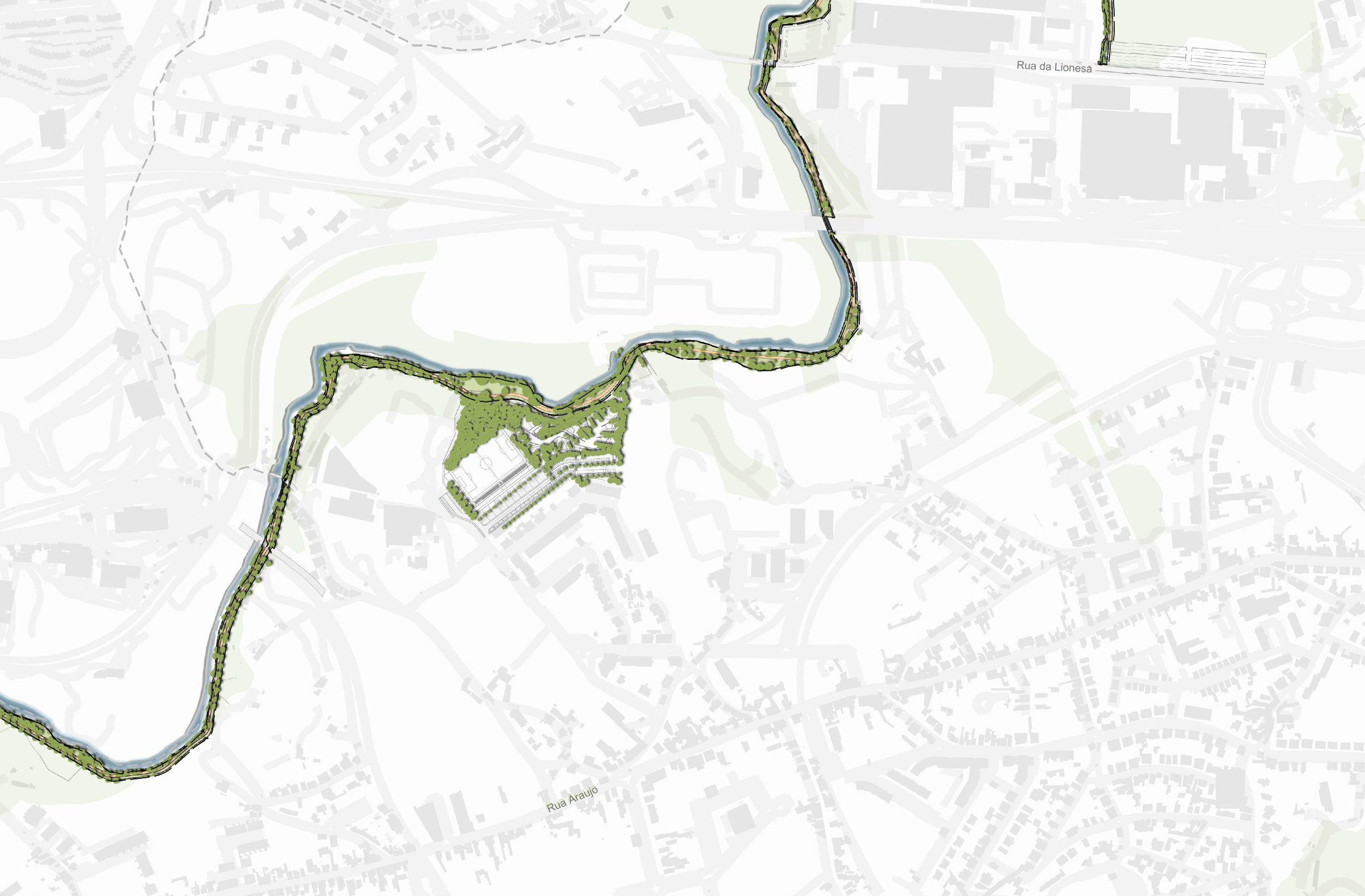
*Fig. 1: Detail of Rio Leça Green Corridor (design by LRC Landscape Architecture) - integrated IAS management and riparian restoration will be implemented along the Leça riverine greenway, in partnership with the Matosinhos City Council
LIFE SOLANUM addresses the growing threat of the invasive alien species Solanum mauritanum, proposing the implementation of ecological restoration projects in 26 demonstration sites across 11 cachments, spanning from expanding populations in the Azores to emerging invasion fronts in NW Iberia.
The ultimate conservation objective of LIFE SOLANUM is the improvement of ecological conditions in riparian, native forest habitats of european importance. The integrated management of S. mauritianum is the entry point for restoring ecosystem connectivity and enhancing long-term resilience in degraded, vulnerable catchments.
By integrating habitat restoration, invasive-species management, ecological monitoring, policy implementation and stakeholder engagement within a coherent territorial framework, LIFE SOLANUM provides a practical model for implementing the EU Nature Restoration agenda on the ground beyond conventional conservation approaches.
LIFE SOLANUM is a 4-year project involving the Regional Directorate for Environment and Climate Action (DRAAC) and the Regional Secretariat for Agriculture and Food (SRAA), Regional Government of the Azores, Matosinhos City Council, the Centre for Ecological Research and Forestry Applications (GRUMETS/CREAF), the Spanish National Research Council (ICM/CSIC), and ORLA - Observatório das Ribeiras e Lagoas, CRL (ORLA)
The project establishes a demonstrably transferable catchment-scale restoration model that can be adapted to other IAS and restoration contexts across Macaronesia and Atlantic Europe - with its replication already formally supported by the Institute of Forests and Nature Conservation of Madeira (IFCN), Fundación Canaria Reserva Mundial de la Biosfera La Palma, Dirección-General de Transición Ecológica y Energia, Conselho Insular de Águas de La Palma and Cabildo de La Palma, Ministerio Para La Transición Ecológica Y El Reto Demográfico de España, and Area Metropolitana do Porto (AMP)